
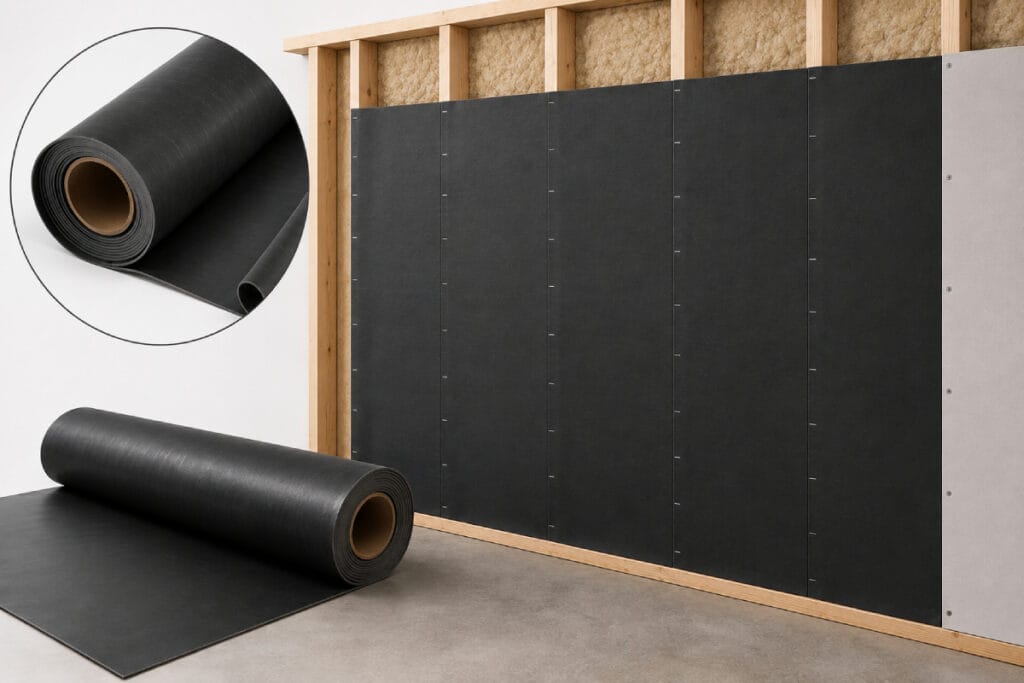
What Is MLV? A Beginner’s Guide to Mass Loaded Vinyl Soundproofing
What is MLV, and how does it fit into a soundproofing system? Mass-loaded vinyl is a dense, flexible material designed to reduce sound transmission through walls, ceilings, floors, and other building assemblies. Unlike acoustic foam or decorative panels, which improve sound quality inside a room, MLV is used to help block noise from traveling between spaces.
Effective sound isolation usually requires a combination of strategies. A well-designed assembly uses mass to resist vibration, airtight construction to eliminate sound leaks, and, in many cases, damping or decoupling to reduce vibration transfer between building materials. Mass loaded vinyl (MLV) is one of the most widely used products for adding mass without dramatically increasing the thickness of a wall or ceiling.
Whether you’re planning a home theater, recording studio, office, or simply trying to reduce noise between rooms, understanding how MLV works can help you choose the right soundproofing material for your project.
What is MLV?
MLV Stands for Mass Loaded Vinyl
At its core, mass loaded vinyl is a dense, flexible sound blocking material that’s designed to reduce sound transmission through walls, ceilings, and other building assemblies. Instead of absorbing sound inside a room, it acts as a noise barrier material by adding weight to surfaces, making it harder for sound waves to pass through.
Unlike plywood, cement board, or additional framing, MLV provides significant mass in a relatively thin profile. A typical MLV sound barrier is only about ⅛” thick, making it practical when space is limited but better sound isolation is needed.
Because it’s supplied in rolls or sheets, installers can use it in a variety of applications, including behind drywall, above ceilings, and inside equipment enclosures. It can also be wrapped around ductwork when the duct is properly decoupled from surrounding building components to help reduce sound transmission.
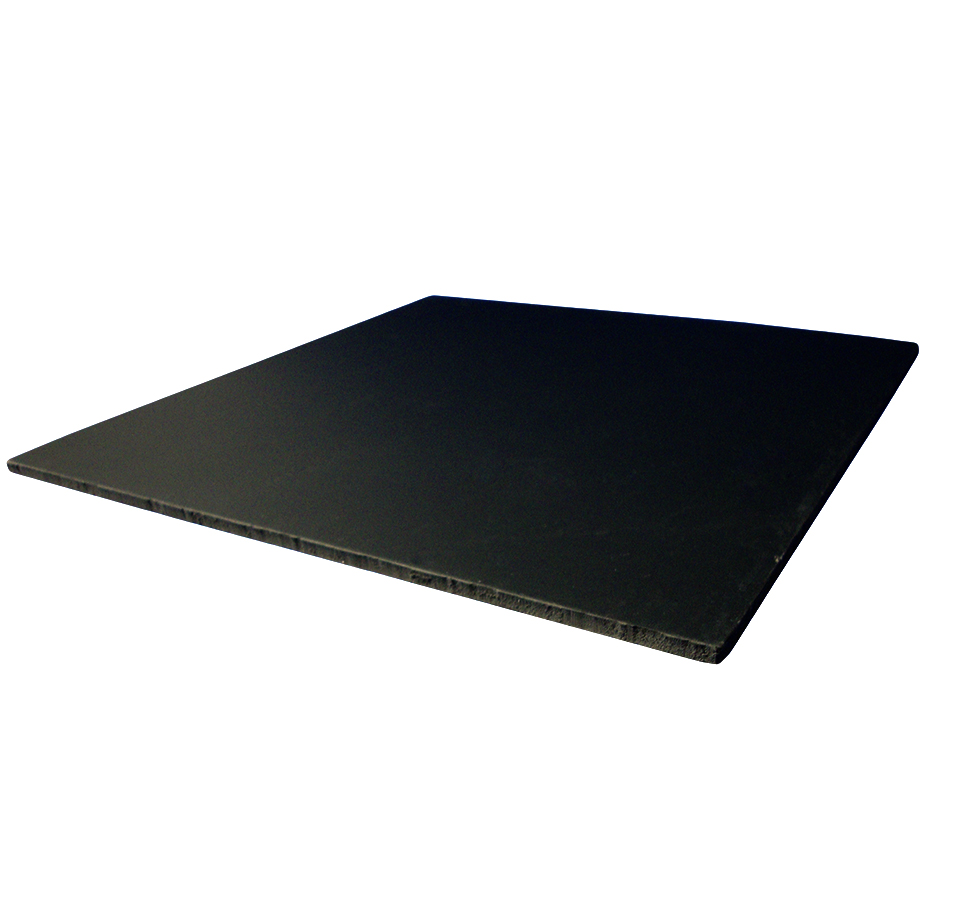
Sample cut of a 4′ x 4′ piece of rolled mass loaded vinyl
Why MLV Is Different from Acoustic Foam or Panels
One of the biggest misconceptions about MLV soundproofing is that it performs the same job as acoustic panels. It doesn’t.
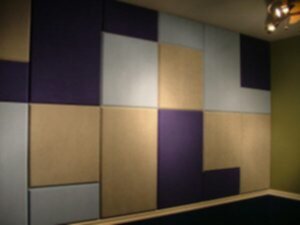
Acoustic panels are designed to absorb sound reflections within a room, improving speech clarity and reducing echo. MLV serves a different purpose. It’s designed to help block sound from traveling through a wall, ceiling, or enclosure by adding mass to the assembly.
Understanding that distinction is important because many successful projects use both approaches. Acoustic treatment improves what you hear inside the room, while mass loaded vinyl soundproofing helps keep unwanted noise from traveling to the next space.
Common MLV Specifications to Know
Although products vary, most MLVs used in commercial and residential projects shares several common characteristics.
| Feature | What It Means |
| Material type | Flexible sound barrier |
| Primary purpose | Reduces sound transmission |
| Common density | 1 lb. per sq. ft. |
| Common thickness | ⅛ inch (.125”) |
| Product rating | STC 26 (product rating only) |
| Available formats | Rolls and 2’x4’ and 4’x8’ sheets |
| Common applications | Walls, ceilings, equipment enclosures, and decoupled ductwork |
| Not recommended for | Soundproofing floors as a primary solution; use an acoustic flooring underlayment instead |
Acoustical Geometry offers both internally rip-stop scrim reinforced and non-reinforced MLV products.
Standard (non-reinforced) vinyl is commonly used behind walls and ceilings, while the reinforced option is better suited for hanging or grommeted installations where additional strength is needed.
What Does Adding Mass Do to Block Sound?
More Mass Makes a Surface Harder to Move
To understand how to block sound, it helps to understand what happens when sound reaches a wall or ceiling. Sound waves create vibration, and those vibrations travel through building materials into the next room.
Lightweight walls and ceilings tend to vibrate more easily, allowing more sound to pass through. Adding density makes the assembly harder to move, reducing the amount of sound energy that transfers through it.
That is why MLV is commonly used to add mass to walls and ceilings. It adds significant mass in a relatively thin, flexible layer, making it useful for improving wall sound isolation and ceiling sound isolation without dramatically increasing thickness.
MLV Helps with Airborne Noise
Most MLV soundproofing applications focus on airborne noise reduction, including voices, televisions, music, traffic, and general environmental sound.
When MLV is added to a wall or ceiling assembly, the extra mass helps reduce sound transfer through the structure. However, it is important to keep expectations realistic. Doors, vents, outlets, windows, and unsealed gaps can still leak sound even when the surrounding assembly includes high-quality soundproofing materials.
Mass Is Only One Part of Soundproofing
Effective mass loaded vinyl soundproofing usually combines several strategies working together as a complete sound isolation assembly.
Mass helps block sound transmission, but sealing, damping, and decoupling also play important roles.
- Acoustic sealant helps close air gaps around seams and penetrations.
- Damping products reduce vibration transfer between rigid layers.
- Decoupling systems help break structural vibration paths.
- Acoustic absorption products improve sound quality inside the room.
That’s why comparisons like Green Glue vs MLV or MLV vs drywall can be misleading. The products perform different jobs and are often used together rather than as direct replacements.
Read More: Sound Isolation vs. Sound Absorption: What’s The Difference?
Where Should You Use Mass Loaded Vinyl?
Walls
Walls are one of the most common applications for MLV. It is frequently used for soundproofing walls in bedrooms, home offices, apartments, duplexes, podcast rooms, and home theaters where speech privacy or noise control is important.
Depending on the project, MLV may be installed over studs before drywall or added over an existing wall and covered with a finish layer during renovation work.
Ceilings
MLV is also widely used for soundproofing ceilings, especially in basement theaters, apartments, studios, and offices below noisy rooms.
In many ceiling assemblies, the material is installed above an additional drywall layer to help reduce sound transfer between floors.
Floors
While MLV can add mass to a floor assembly, it is generally not the best solution for impact-related structure-borne noise such as footsteps or dropped objects. Those problems usually require underlayments, isolation systems, or damping strategies.
MLV works best when it can flex slightly as sound energy hits it. As the material moves, a small amount of energy is converted into heat rather than fully passing through the assembly.
A simple way to picture this is to imagine a loose piece of canvas hanging in a room. If you throw a baseball into it, the canvas flexes and absorbs energy. If that same canvas is glued tightly to the wall, the ball bounces off because the material can no longer move enough to dissipate the impact.
MLV behaves similarly. When it’s tightly compressed between hard surfaces where it cannot flex, its effectiveness drops significantly. That’s part of the reason acoustic flooring underlayments are usually more effective for floor noise control than using MLV alone.
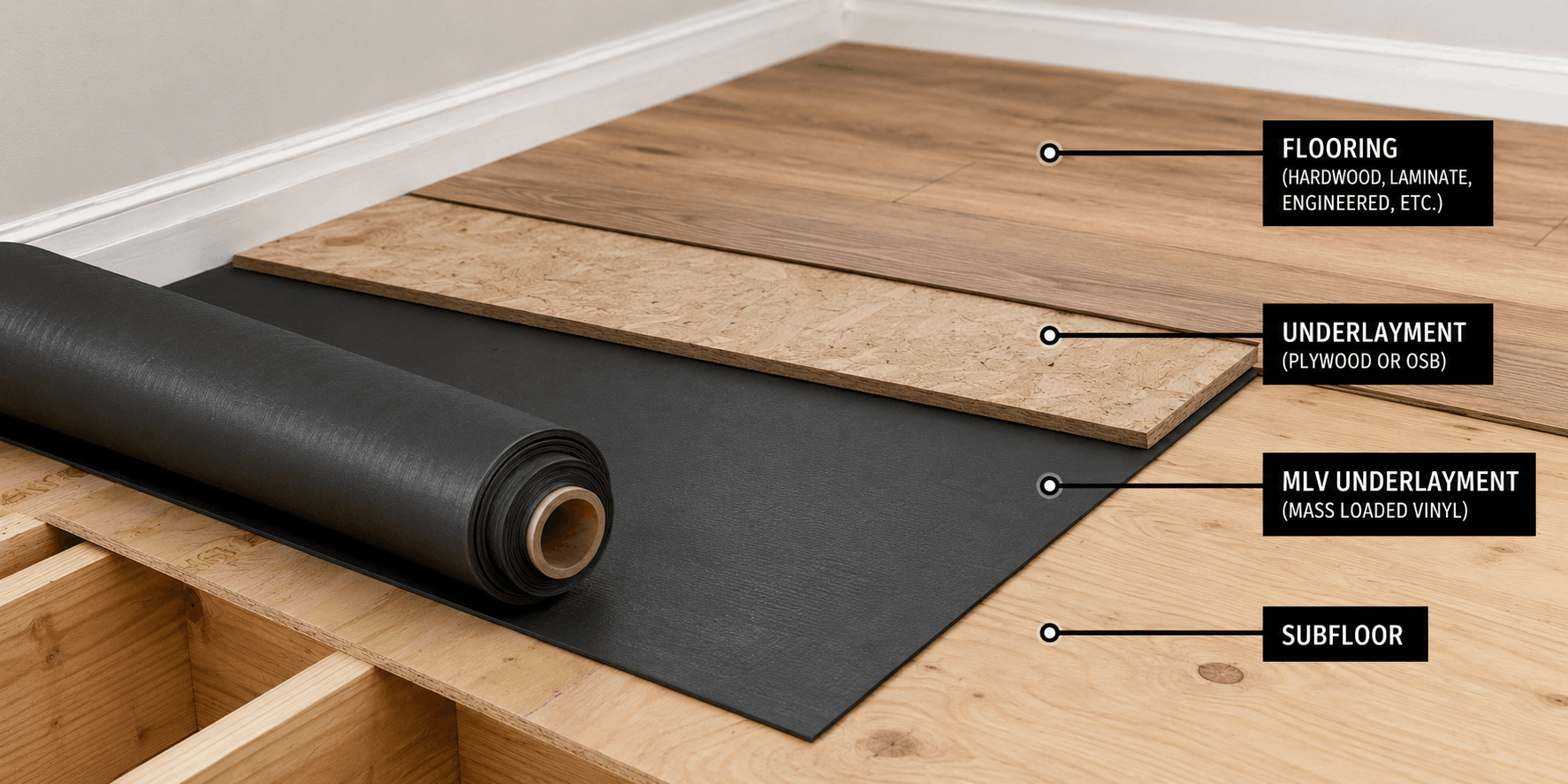
Rendering of how lass loaded vinyl fits between the top flooring and subfloor with a layer of underlayment (plywood or OSB typically) on top of the MLV.
Doors, Ductwork, Machinery, and Enclosures
Beyond walls and ceilings, MLV is also used in machinery enclosures, equipment rooms, and some ductwork applications.
In these situations, it functions as a flexible noise barrier material that helps reduce sound transmission from mechanical systems. Ductwork applications generally perform best when the MLV is decoupled from the metal surface using fiberglass or foam rather than being bonded directly to the duct.
Best Applications for MLV Soundproofing
Home Theaters and Media Rooms
Home theaters are one of the most common uses for mass-loaded vinyl because loud playback and bass energy can easily travel into adjacent spaces.
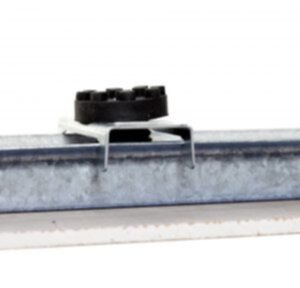
In many projects, MLV is combined with double drywall, Green Glue, door seals, and RSIC clips to improve overall isolation performance. Because low frequencies are difficult to control, MLV typically works best as one part of a larger soundproofing strategy rather than a standalone solution.
Recording Studios, Podcast Rooms, and Music Practice Rooms
Recording studios and podcast rooms require better isolation than standard residential spaces, especially when microphones or amplified playback are involved.
In these environments, MLV can help reduce sound transfer into neighboring rooms while limiting outside noise entering the recording space. It is commonly used inside wall and ceiling assemblies as part of a broader sound isolation assembly that may also include insulation, damping, and decoupling systems.
Apartments, Condos, and Shared Walls
Neighbor noise is one of the main reasons people research mass loaded vinyl soundproofing. Shared walls in apartments, duplexes, and condos may allow voices, televisions, and general living noise to pass between units.
MLV can help improve separation between spaces, particularly when combined with additional drywall and proper sealing. However, sound can still travel through doors, windows, vents, and other weak points in the construction if they are not addressed properly.
Offices and Commercial Spaces
MLV is also used in offices, conference rooms, medical facilities, schools, hotels, retail spaces, and other commercial environments where privacy and noise control are important.
In these applications, the material is usually installed inside partitions, ceilings, or equipment enclosures to help reduce sound transmission between occupied spaces.
How to Install MLV in a Wall or Ceiling Assembly
MLV performs best when the rest of the assembly is designed correctly. Before installation, consider where the material will sit, whether additional drywall will be added over the MLV, how seams and penetrations will be sealed, and whether doors, windows, outlets, or vents may still allow sound leaks elsewhere in the assembly.
MLV Installation Steps
- Measure the wall or ceiling area and cut the MLV to fit.
- Position the material over wall studs, ceiling joists, or existing drywall depending on the assembly design.
- Fasten the MLV securely to the framing or surface, placing fasteners along structural members where possible.
- Keep seams tight or slightly overlapped to help limit sound leakage.
- Seal seams, perimeter edges, outlets, and penetrations with acoustic sealant or barrier tape.
- Cover the MLV with drywall or another approved finish surface when required for the application.
Common Installation Mistakes
Even high-quality materials can perform poorly when installation details are overlooked. Common mistakes include:
- Leaving gaps around edges or penetrations
- Failing to seal seams
- Ignoring outlets, vents, or recessed fixtures
- Assuming MLV alone will stop all noise
- Installing material without checking the load capacity
- Skipping finish layers where required
- Treating only one surface while sound leaks remain elsewhere
Many soundproofing failures are caused by incomplete assemblies or overlooked flanking paths rather than the material itself.
Shop Mass Loaded Vinyl for Your Soundproofing Project
By the time people start asking “what is MLV?” they are usually dealing with real-world noise problems – loud neighbors, home theater sound transfer, office privacy issues, or unwanted mechanical noise between rooms. In many of those situations, mass loaded vinyl provides a practical way to add sound-blocking mass without dramatically increasing wall or ceiling thickness.
Acoustical Geometry offers mass loaded vinyl solutions for walls, ceilings, ductwork, and equipment enclosures for residential and commercial soundproofing projects, along with the product knowledge and application guidance to help support a successful installation.
FAQs
How thick is mass loaded vinyl?
Most standard MLV products are approximately ⅛ inch (.125”) thick.
Can MLV be used on existing walls?
Yes. MLV can be added to existing walls as part of a larger soundproofing upgrade, typically along with additional drywall, sealing, or decoupling methods to improve overall performance.
Do you need drywall over MLV?
Not always, although many assemblies include drywall for protection and finishing purposes.
Can MLV be left exposed?
While some commercial or industrial applications leave MLV exposed, most residential and finished-space installations cover it with drywall or another finish layer for appearance, durability, and safety reasons.
Can MLV be used on ceilings?
Yes. MLV is commonly used in ceiling assemblies for apartments, theaters, studios, and offices.
Can MLV be used under flooring?
Yes, but acoustic flooring underlayments are usually more effective for impact noise control.
Does MLV help with impact noise?
Not very well on its own. Impact vibration usually requires isolation or underlayment systems.
What STC rating does MLV have?
MLV products may carry STC ratings, but actual performance depends on the complete wall or ceiling assembly.
Can MLV be used with RSIC clips?
Yes. MLV is often combined with RSIC clips in higher-performance assemblies.
When is MLV not the right soundproofing solution?
MLV is not the best solution for room echo, weak doors or windows, or heavy impact vibration by itself.
About author










Add comment
You must be logged in to post a comment.